

Daegu-based founder Daetac Han is turning nostalgic K-street food into a cultural business model with Nabjack Friends that merges taste, content, and commerce.
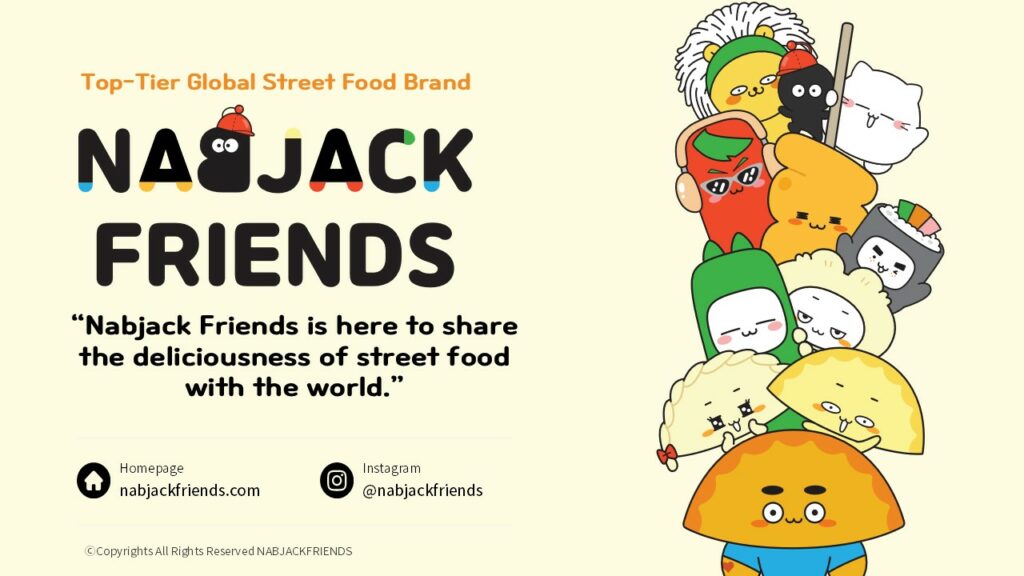
As Korea’s creative economy diversifies beyond K-pop and K-drama, a new generation of startups is turning everyday culture into exportable intellectual property. Among them is Nabjack Friends (납작프렌즈) — a Daegu-based brand that reimagines Korean street food favorites as lovable characters with global appeal.
Founded by Han Daetac, the company bridges taste and storytelling through a hybrid model that combines food manufacturing, design IP, and lifestyle goods. It’s part of a wider trend in Korea’s content industry, where brands are evolving from pure media producers into experience-based IP creators. According to data from the Korea Creative Content Agency (KOCCA), the nation’s character licensing market exceeded 18 trillion KRW in 2024, signaling strong growth potential for cultural products that integrate emotional storytelling with tangible experiences.
In this exclusive interview, Han discusses how Nabjack Friends was born from his family’s dumpling shop in Daegu’s Chilseong Market, the philosophy behind “finding charm in imperfection,” and how he’s building a content-to-commerce model that connects local nostalgia to global audiences.
Interview
Q. What sparked the idea of turning K-street foods into characters?
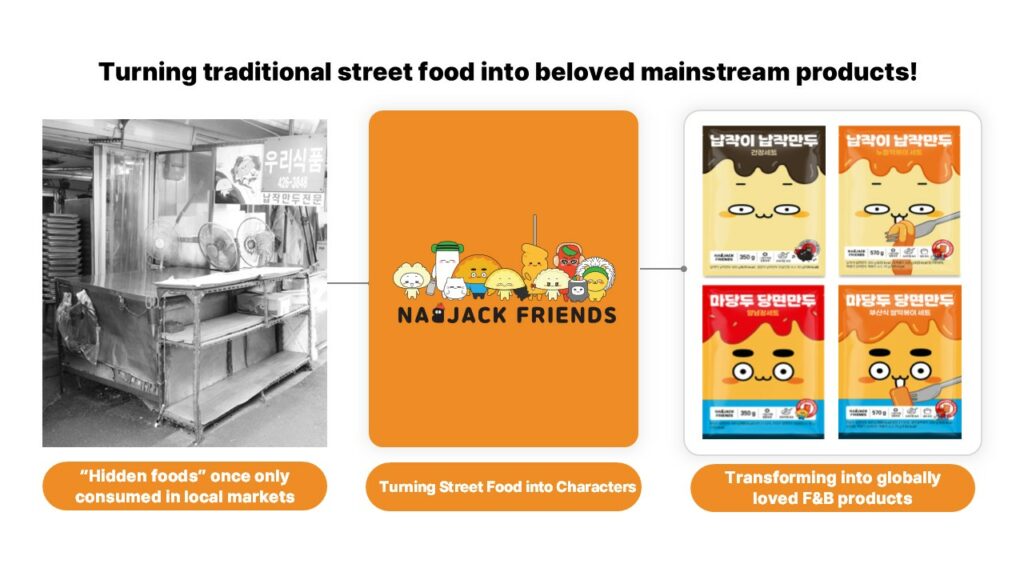
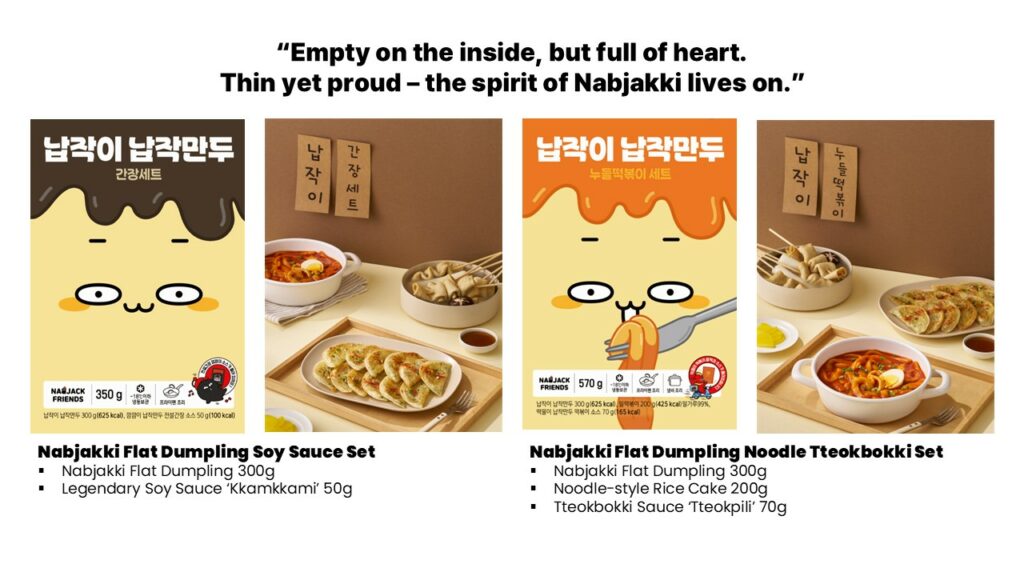
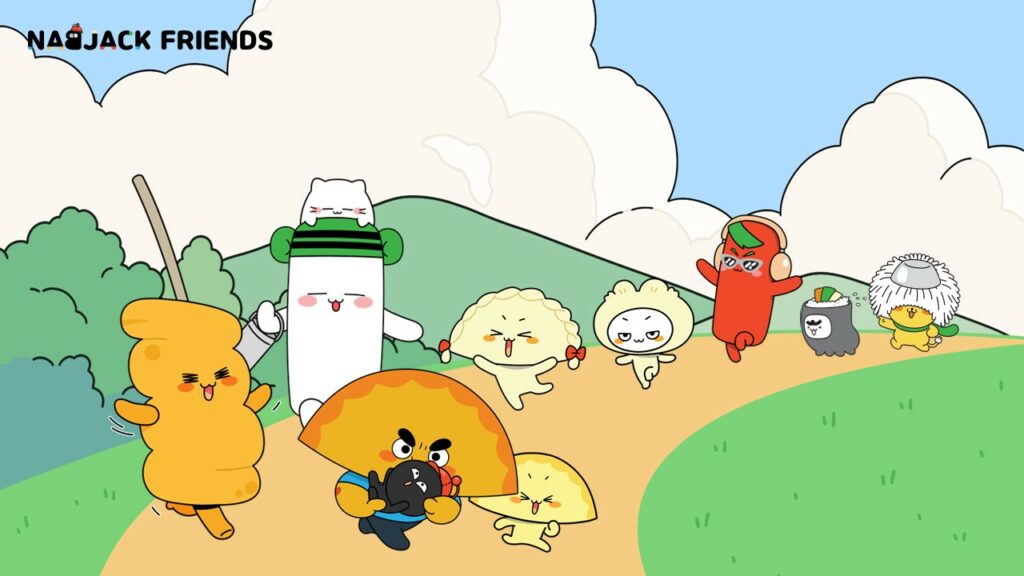
Han Daetac (HD): My roots are in Daegu’s Chilseong Market. I grew up watching my father, Han Byung-gyu, hand-make flat dumplings for over 30 years—dumplings that were sometimes teased for being “flat.” We chose to focus on that very deficiency. Like our dumplings, we turned what looks minor or imperfect into a badge of identity, and gathered friends with similar “flaws” to build the world of Nabjack Friends. To extend a one-time eating experience into a lasting cultural asset, we designed a path of “taste memory → character attachment → repurchase & sharing.”
Q. How did your personal background shape Nabjack Friends?
HD: I value the humbleness and consistency I learned in Daegu, and I grasped the power of content early on. As a kid I collaborated with Seoul Metropolitan Government and Kakao on herstory_is_history (A Girl’s Journey), which taught me how content moves people in the real world. Since then I’ve built hands-on branding and data-driven operations. Nabjack Friends aims to be not a sentimental brand, but an operationally sound one that spans manufacturing, cost, and distribution.
Q. What does “comfort and joy in daily life” mean as a design and brand philosophy?
HD: Like Laozi’s wu-wei, we avoid exaggeration and let the essence surface. Our characters gently lift small everyday moments and create a little smile. At the same time, management is science: we monitor reach → engagement → conversion → repeat purchase, and we scale formats that prove themselves. Recently, our Instagram crossing 10K followers in about a month validated this direction.
Building a Character IP Around Food
Q. Why food—specifically street food—instead of other cultural icons?
HD: Street food exists everywhere; it’s the world’s soul food. It grew out of everyday life, carries memories of market alleys, after-work walks, and festivals, and it’s instantly legible in one visual. It also expands naturally into packaging, goods, animation, pop-ups, and food lines, which makes it ideal for IP development.
Q. How do you balance authenticity with universality for non-Korean audiences?
HD: We protect the essence with recipe and quality, and localize expression for each market. Without diluting the core, we tune copy, rhythm, memes, color tone, and usage context for Japan, Hong Kong, Singapore, and beyond. In short: Same Essence, Local Voice.
Q. How does a snack become a character?
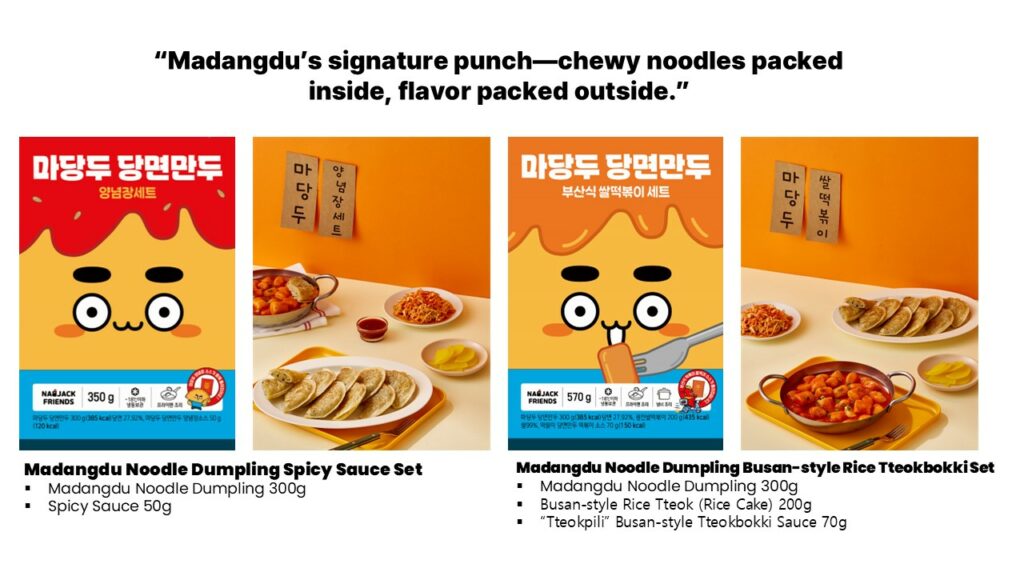
HD: We start by closely observing the real item—its texture, movement, or even sound. Then we translate flavor into personality: mild foods might feel gentle, spicy ones energetic. We highlight small quirks, give each a signature expression or catchphrase, and test whether it can live naturally on packaging, social media, or merchandise. That’s how a food becomes a friend.
Brand & Business Model
Q. How do your food, IP, and lifestyle categories reinforce one another?
We operate a cycle: content creates awareness, products deliver the physical experience, and characters build long-term attachment. Each part lowers customer acquisition costs for the others. It’s a self-reinforcing system where storytelling and product experience drive each other.
Q.: What have been the challenges of producing food products vs. digital content/merch?
HD: Food involves safety, lead time, shelf life, and cold-chain risk. Digital and merch have faster testing cycles. So we validate demand with content first, then scale production through partners (OEM/distribution) to balance risk and return.
Q. How important are partnerships like CJ Foodville for scaling?
HD: The key is the triangle of Taste – Content – Distribution.
- Taste (Product): Standardize recipes; manage moisture, bite, aroma; minimize process variance; watch NPS, star ratings, return rates.
- Content (IP): Character narrative, package copy, and visuals that win the first 3 seconds at shelf / 1 second in feed. Launch calendar = teasing → launch → UGC/reviews → retargeting.
- Distribution: Channel unit economics (fees, rebates), lead time & temperature specs, shelf/search/banner/tasting ops, promo calendars, packaging compatibility—designed coherently for speed.
When all three run in sync, content-generated demand converts at the shelf, taste locks repeat purchase, and distribution accelerates inventory turns and cash flow. Our axiom: “Content opens demand, taste locks repeats, distribution makes speed.”
Cultural Storytelling & Globalization
Q. Where do K-street food characters fit within the K-culture export wave?
HD: We believe K-street food characters are a gateway to K-culture. If K-Pop and K-Drama capture the eyes, K-street food moves the palate. It invites easy trials and instant experiences. If we keep doubling down on the essence of content, K-street food characters can stand alongside K-Pop and K-Drama—and even alongside Japanese animation in cultural presence.
Q. How do you adapt storytelling for Japan, Hong Kong, and Singapore?
HD:
- Japan: detail, craftsmanship, restrained humor.
- Hong Kong: faster rhythm, gifting culture, packaging aesthetics.
- Singapore: multicultural sensitivity, concise information, convenience.
Q. What reactions have you seen from global audiences unfamiliar with these foods?
HD: We see a clear four-step funnel: “Cute → Curious → Search → Try.” The characters’ emotional arc lowers cultural barriers. As our Instagram grew, “Where can I buy this?” DMs surged—a strong sign of content-to-commerceconversion.
Entrepreneurial Journey & Vision
Q. Biggest challenges so far (funding, IP, manufacturing, brand awareness)?
HD:
- Balancing capital and speed—learn fast without over-investing;
- Running IP and manufacturing in parallel—creative plus quality control;
- Keeping consistency and differentiation across channels and countries. Our approach: test small, learn fast, replicate big.
Q. In five years, is Nabjack Friends a global food-plus-character franchise—or a cultural storytelling platform?
HD: Both. Near-term (1–2 years), we expand character-led F&B and deepen partnerships. Mid-term (3–5 years), we evolve into a platform that integrates animation, licensing, and retail experiences—turning taste memories into cultural IP.
Q. Lessons learned as a Daegu-based founder vs. building in Seoul?
HD: Choose persistence over flash, essence over excess. Staying close to the market’s voice and the factory’s rhythm is invaluable. Still, emotion doesn’t last without data, cost control, lead time, and conversion. We hold to Laozi-like simplicity for the essence—and scientific management for execution.
Key Takeaways
- Local flavor, global IP: Nabjack Friends turns Korean street food nostalgia into character-based cultural assets.
- Integrated growth loop: Content drives demand, taste secures loyalty, and distribution delivers scale.
- Charm in imperfection: The brand celebrates authenticity by transforming “flaws” into identity.
- Smart localization: Keeps Korean essence while adapting style and tone for each market.
- Creative + data-driven: Combines storytelling with disciplined operations for sustainable growth.
Nabjack Friends captures the next chapter of Korea’s creative economy — where cultural storytelling meets business design, and where something as simple as a dumpling can become a global brand with heart.
Company Snapshot: Nabjack Friends
| Category | Detail |
|---|---|
| Startup Name | Nabjack Friends (납작프렌즈) |
| Founder | Han Daetac |
| Flagship Product | Character IP built from Korean street foods; flat-dumpling-led HMR and lifestyle goods |
| Founded | May 2022 |
| Headquarters | Daegu, South Korea (founder base) |
| Partnerships | Character IP built from Korean street foods; flat-dumpling-led–led HMR and lifestyle goods |
| Operating Axiom | “Content opens demand, taste locks repeats, distribution makes speed.” |
| Localization Motto | “Same essence, local voice.” |
| Recent Milestone | Instagram surpassed ~10,000 followers in about one month |
| Website | www.nabjackfriends.com |
Join us on an exciting journey to explore the vibrant world of Korean lifestyle – from the latest beauty tips to the hottest tech and so much more on Facebook, Twitter, LinkedIn, and Flipboard.