

As host of APEC 2025, Korea aims to reshape Asia-Pacific trade. See how the summit could open new export pathways into ASEAN markets.
When South Korea hosts the APEC 2025 Economic Leaders’ Meeting in Gyeongju on October 31–November 1, the global spotlight will be on the country’s role in shaping Asia-Pacific trade dynamics. For Korean exporters eyeing Southeast Asia, the summit is not just symbolic — it may be a turning point in trade policy, regional connectivity, and supply chain alignment.
This article explores how APEC 2025’s agenda could influence Korea’s export relationships with ASEAN markets — what opportunities may emerge, what headwinds exist, and how exporters should position themselves.
Korea & APEC: Trade Ties and Strategic Context
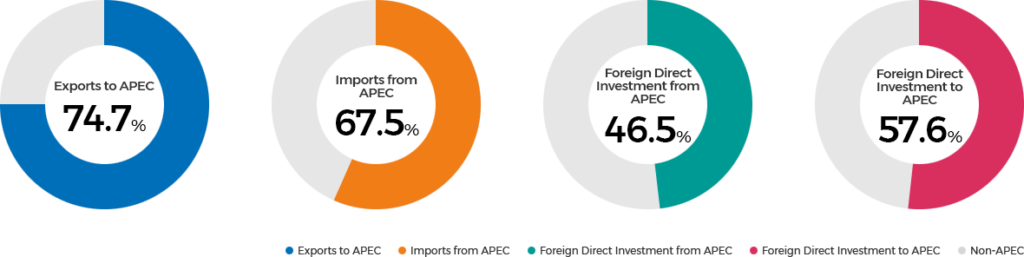
South Korea’s trade and investment relationships are deeply entwined with the APEC bloc. As of 2023, its exports to and imports from APEC economies accounted for 74.7 % and 67.5 % of its total trade in goods, respectively. Moreover, eight of Korea’s top 10 trading partners are APEC members — including Vietnam, Singapore, Chinese Taipei — many of which are ASEAN or closely tied to ASEAN economies.
At the same time, Seoul has been seeking to diversify trade relationships beyond its historical dependence on China and the U.S. In August 2025, Korea’s Trade Minister Yeo Han-koo emphasized that Korea would expand cooperation with APEC economies — especially ASEAN and India — to mitigate risks from changes in the global trade environment.
In parallel, the New Southern Policy, initiated in past administrations, has been an ongoing strategic effort to deepen economic relations with Southeast Asia and India, including expanding trade, investment, and diplomatic ties with ASEAN nations. These policy currents mean that APEC 2025 is unfolding in an environment where Southeast Asia already features in Korea’s export diplomacy.
APEC 2025’s Trade Agenda: What Seoul Is Prioritizing
As host, Korea is steering APEC’s discourse around three thematic pillars: Connect, Innovate, and Prosper. In practice, this agenda compels a focus on resilience in supply chains, digital trade, trade facilitation, and sustainable trade frameworks.
During the APEC Ministers Responsible for Trade (MRT) Meeting in Jeju (May 10–11, 2025), APEC economies reaffirmed those priorities in the joint statement: connectivity through the multilateral trading system; AI innovation for trade facilitation; and prosperity through sustainable trade. The ministers also discussed WTO reform and trade system strengthening as part of restoring confidence in multilateral mechanisms.
One of the most consequential signals from the Jeju meeting was APEC’s warning about export stagnation. The bloc projected that export growth across APEC economies would expand by just 0.4 % in 2025, far lower than in earlier years, citing rising uncertainty and trade friction (especially U.S. tariff pressures). This forecast places additional urgency on strategies that can buffer Korean exporters against volatility.
Also at Jeju, Korea leveraged its chairmanship to host bilateral trade talks with representatives from 14 APEC member economies, seeking to strengthen trade ties and reduce external risks. Collectively, these moves suggest Seoul is trying not just to host but to lead tangible trade diplomacy in the region.
ASEAN: A Rising Anchor for Korean Exports
Even in the flux of global trade tensions, ASEAN has begun to emerge as a more stable export destination for Korea. According to recent reports, South Korea’s exports to ASEAN countries have been increasing, helping compensate for softness in shipments to the U.S. and China. This shift suggests that Korean exporters are already beginning to reorient toward Southeast Asia amid global headwinds.
Several structural conditions favor this trajectory:
- Preferential trade agreements: For example, the Indonesia–Korea Comprehensive Economic Partnership Agreement (IK-CEPA) came into effect on January 1, 2023. Under IK-CEPA, most tariffs on goods between the two nations were eliminated or reduced, covering a broad share of traded items.
- Membership in RCEP: Korea and all ASEAN countries (except a few) are part of the Regional Comprehensive Economic Partnership (RCEP), which provides trade rules, tariff liberalization, and unified rules of origin across its members. While RCEP is not specific to APEC, it is a structural backdrop that complements Korea’s regional trade strategy.
- Market growth & demand shifts: Southeast Asian economies are witnessing rising middle-class consumption, digital adoption, and demand for value-added products (electronics, cosmetics, green tech) — all areas where Korean exporters traditionally excel.
Thus, as APEC’s trade environment pushes for better connectivity and lower trade friction, Korean exporters might find more fertile ground in ASEAN.
Potential Impacts on Korean Exporters & Strategic Positioning
Below are key domains where APEC 2025’s outcomes may tangibly affect Korean exports to Southeast Asia:
1. Trade Facilitation & Digital Customs
One of APEC’s connective imperatives is simplifying cross-border trade flows, reducing red tape, and harmonizing digital processes. If APEC initiatives yield progress in paperless customs, electronic certificates of origin, and mutual recognition of standards, Korean exporters could gain smoother access to ASEAN markets, cutting compliance time and reducing costs.
For SMEs in particular, lower procedural friction can make entering ASEAN feasible where before margins were too slim.
2. AI & Innovation in Supply Chains
During the Jeju MRT meeting, artificial intelligence was explicitly named as a focus area for trade facilitation — e.g., smarter logistics, predictive analytics, and AI-assisted customs risk management. ASEAN countries increasingly compete to uplift their digital and logistics infrastructure. Korean firms with AI, software, and logistics automation competencies are well-positioned to partner or supply these upgrades or to optimize their own ASEAN-oriented supply chains.
3. Green Trade & Sustainability Standards
“Prosperity through Sustainable Trade” is among APEC’s three thematic priorities for 2025. As ASEAN economies start enforcing stricter environmental and carbon-related standards, Korean exporters offering low-carbon products, eco-friendly packaging, or clean energy components may enjoy preferential acceptance.
Exporters will need to align with environmental, social, and governance (ESG) expectations — those ahead of the curve may gain reputational advantages.
4. Geopolitical / Tariff Risk Buffering
One of APEC’s more urgent warnings is that escalating U.S. tariffs could drag down regional exports — and indeed, export expansion is forecast to be minimal (0.4 %). Korea is acutely exposed to U.S.–China trade tensions and tariff spillover risks. The Jeju meeting saw bilateral U.S.–China talks alongside the ministerial sessions, aiming to ease tensions. For Korean exporters to ASEAN, APEC-led progress on reducing trade barriers or improving multilateral coordination may help insulate them from protectionist spillovers.
5. Strengthened Bilateral & Multilateral Partnerships
Korea’s use of APEC 2025 as a platform for high-level bilateral trade talks — engaging 14 economies during Jeju meetings — indicates Seoul’s push to weave deeper connections across Asia-Pacific. These relationships can pave the way for future trade agreements, side deals, or preferential access arrangements with ASEAN economies.
Caveats & Risks to Watch
- The APEC 2025 agenda is ambitious, but implementation gaps are inevitable. Even if agreements are made on facilitation or AI, translating them into enforceable protocols across 21 economies is complex.
- Some ASEAN economies may have varying capacities — not all will move at the same pace in digital infrastructure, regulatory reform, or sustainability adoption — making harmonization imperfect.
- Geopolitical tensions, especially U.S.–China trade clashes, may upset the progress of APEC’s cooperative agenda or lead to last-minute backsliding on commitments.
- Korean exporters in heavily tariff-sensitive product lines (e.g., steel, certain autos) may still face protectionist barriers beyond what APEC agreements can soften.
What Exporters Should Do Now
- Audit regulatory and compliance readiness — ensure your products can meet anticipated sustainability, digital, or data standards across ASEAN markets.
- Invest in digital logistics & AI tools — automation, predictive demand, and real-time tracking will become more important as trade facilitation improves.
- Monitor bilateral trade talks and agreements emerging from APEC margins, especially with ASEAN nations.
- Diversify product mix to “green/smart” variants — aligning with sustainability trends positions you better in the evolving regional trade climate.
- Engage with trade associations or government support programs to stay abreast of APEC-derived incentives or export channels.
Conclusion
APEC 2025 is more than a summit — it’s a testing ground for Korea’s trade leadership. For exporters targeting Southeast Asia, success will hinge on agility: embracing digital trade, sustainability, and regional partnerships as the new pillars of competitiveness.
Join us on an exciting journey to explore the vibrant world of Korean lifestyle – from the latest beauty tips to the hottest tech and so much more on Facebook, Twitter, LinkedIn, and Flipboard.