
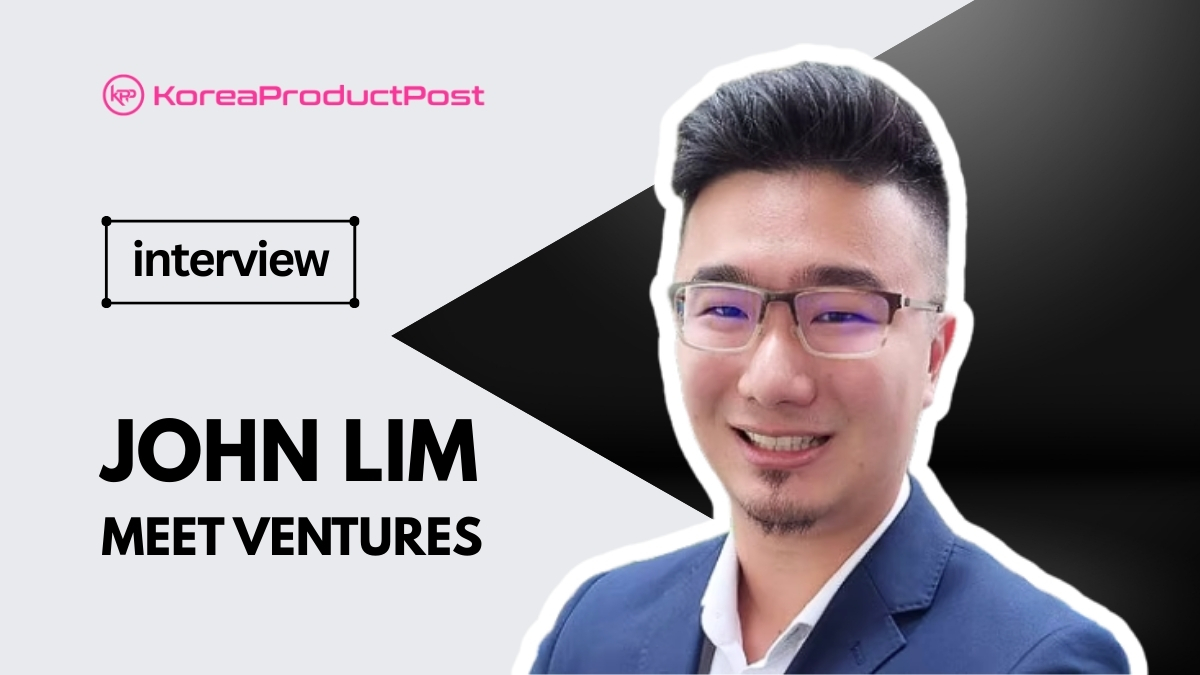
In Asia’s fast-evolving startup landscape, few people have had as diverse a journey as John Lim, Partner at Meet Ventures. From managing corporate accelerators for IBM and CISCO during his early days at SGInnovate, to advising blockchain startups at LongHash Ventures, and eventually founding Meet Ventures through an unexpected consulting project, John has seen the ecosystem from multiple angles.
Today, Meet Ventures sits at the intersection of venture capital, corporate innovation, and startup acceleration, with a unique focus on bridging Korean startups into Southeast Asia. In this interview, John shares his insights on the strengths and challenges of Korean founders, the shifting investment appetite in the region, and what it truly takes for a startup to win over investors and corporate partners in Singapore.
Korea–SEA Startup Expansion: Insights from John Lim, Meet Ventures
Insights from John Lim, Partner at Meet Ventures, reveal how Korea’s mature startup ecosystem and Singapore’s role as a financial hub are creating powerful new opportunities across Asia.
From Web3 to travel-tech to cultural content, Korean founders are increasingly looking south — and Southeast Asia’s investors and corporates are ready to meet them. One thing is clear: the future of Asia’s startup growth will be written in collaboration, not competition.
From VC to Founder: John’s Journey
Q: You’ve worked across venture capital, corporate accelerators, and innovation consulting. How did your journey lead you to become a Partner at Meet Ventures?
John: I started my career as a Management Associate at a VC fund called SGInnovate. That first job greatly shaped my career as it taught me the basics of VC and also gave me the opportunity to manage corporate accelerators for IBM and CISCO. After that, I continued to hone my skills at other firms like KPMG Innovate and LongHash Ventures.
Later on, a friend reached out to me and asked me to assist his pre-IPO company on a consulting project. This required me to quit my job and start Meet Ventures, so I did, and the Pre-IPO company became our very first client. We helped this client craft their initial innovation story and accompanied them in their journey to be listed on the Tokyo Stock Exchange.
Q: Meet Ventures also manages a fund — could you share the kinds of deals or sectors you’re most excited about right now?
John: Meet Fund 1 is our maiden fund, and we are excited about data-centric startups. This could include, but is not limited to, AI and blockchain startups. We believe that AI is going to become the brainpower behind all companies in the future. We also believe that blockchain is going to form the nervous system connecting different businesses and industries.
Why Korea Stands Out in Asia’s Startup Scene
Q: What’s your impression of the Korean startup ecosystem compared to other markets in Asia?
John: The Korean startup ecosystem is definitely one of the more mature ones in Asia.
The Korean government is a strong supporter of startups and has established multiple support channels for startups at all stages. For example, early-stage startups can choose from hundreds of incubators and accelerators, growth-stage startups can get expert advisory for their market expansion plans, and deep tech startups have generous access to grants.
The Korean conglomerates are also actively supporting the startup ecosystem. Many have their own CVC department, some have an innovation department to work on POCs with startups, and some have a venture building department to create their own spin-offs.
Korean Startups: Strengths & Growing Pains
Q: Have you worked directly with Korean startups? If so, what strengths and challenges have you observed when they enter the Southeast Asian market?
John: Meet Ventures has worked with more than 200+ Korean startups over the years. A key strength of Korean startups is that they are usually very strong in product development and technical innovation. However, many are weaker when it comes to marketing their products to a global audience. Probably due to language barriers and a lack of fluency in English.
This is also why many Korean government agencies have engaged us to help their startups bridge the gap in global marketing and go-to-market strategies.
Where Korean Innovation Meets Regional Opportunity
Q: Which sectors or technologies from Korea do you believe have the most substantial potential in Singapore and the broader APAC region?
John: The content industry is definitely a big market, given the influence of K-pop and K-culture. There is also strong government support from the likes of KOCCA to promote Korean content startups in the Southeast Asia region.
The travel industry is another big market, with Korean success stories such as H20 Hospitality and Stayfolio expanding into the Southeast Asia region. Travel-related government agencies such as KTSC have also set up shop in Singapore.
The Web3 industry is another potential market. Korea is one of the most advanced nations when it comes to crypto and blockchain regulations, whereas Singapore is a key financial hub in APAC. Korean Web3 startups entering Singapore can gain immediate access to one of the best capitalised markets in the region.
The Shifting Investment Landscape in SEA
Q: From your perspective, how is the investment appetite in Singapore and Southeast Asia evolving, especially for early-stage versus growth-stage startups?
John: I think that investment has definitely slowed down both at the early-stage and growth-stage. This could be due to a few reasons, such as global political uncertainty, economic tariffs, a high-interest-rate environment, and the fact that many VC funds in the region underperformed recently.
However, things might get better now that interest rates are starting to get lower. This could encourage LPs to reallocate some of their funds in the capital markets to alternative investments such as VC.
What Investors Look For in Startups
Q: What qualities do you look for in a startup before deciding to invest, and how might those apply to Korean founders seeking regional capital?
John: Meet Ventures prefers to invest in startups with a strong moat and a strong founder. A strong moat can be in the form of patented technology, proprietary big data, or exclusive networks. A strong founder is someone with relevant experience and success in the field in which they are.
Assuming the Korean founders already possess both the above criteria, they will then need to explain why they are looking for funding from foreign VCs instead of Korean VCs. They will also need to understand the valuation norms in the market they are fundraising from, so as to stand a better chance of securing funding.
Expansion & Fundraising Advice for Korean Startups
Q: You’ve advised that startups should build strong local traction before expanding overseas. What would that roadmap look like for a Korean startup aiming to enter Singapore?
John: I think that the best time to consider expanding overseas is when a startup has reached at least Seed or Series A. This is when the startup has achieved product-market fit and already acquired sizeable funding for expansion.
During the early years of a startup, multiple pivots are to be expected. It is usually easier and cheaper to pivot and fail and relaunch in the home market than in a foreign market. That is why it makes more sense for early-stage startups to focus on their home market, whose priority should be to quickly achieve product-market fit in the cheapest and most efficient manner possible.
Navigating Cross-Cultural Communication
Q: What do Singapore-based investors typically expect from foreign startups in their first meeting?
John: Singaporean investors usually have a mental checklist and expect to cover all key points of a pitch deck within the first meeting. This includes basic things like problem-solution fit, market size, existing traction, founder background, etc. We usually also try to ask questions to determine how well the founder understands their industry and customer pain points.
Q: Are there cultural or communication differences Korean founders should be aware of when pitching to Southeast Asian investors?
John: I think there are definitely cultural and communication differences within Southeast Asia. For example, Singaporean investors might be more logical and straightforward, whereas Indonesian investors might be more open if the relationship is warm. That being said, above are some generalisations, and startups should do their own research prior to meeting a prospective VC.
Finding Your First Corporate Partner
Q: What’s the most effective way for a Korean startup to land its first corporate partner in Singapore?
John: One way could be to identify Korean corporates with a presence in Singapore and approach their local subsidiary. Appealing to the sense of familiarity could aid in securing a partnership.
Another way could be to identify corporates with a CVC or startup-related department. These corporates might already have prior experience working with startups and therefore are more open to potential partnerships.
Q: In your experience, what are the most effective ways for a Korean founder to connect with local investors, corporates, and customers in Singapore?
Knock and the door shall be open to you.
– John Lim, Meet Ventures
John: For cold leads, the best way is to simply reach out via email or LinkedIn. Keep trying and you will definitely get at least a few replies or meetings.
For warm leads, you can seek the help of a consultancy firm like Meet Ventures with deep local networks to make personal introductions.
Red Flags That Deter Investors
Q: From an investor’s point of view, what are the top 3 red flags that make you walk away from a deal with a foreign startup?
John: The first is blatant lying or being untruthful in their pitch deck or financials. The second is when the market size is too low or the valuation is too high for the startup stage. The third is impractical unit economics for example when a startup spends $10 CAC for $1 CLTV.
The Next Chapter of Korea–Singapore Ties
Q: Looking to the next five years, where do you see the biggest opportunities for Korea–Singapore collaboration in the startup and investment space?
John: The world is changing and Asian economies need to start collaborating with each other more closely than ever. Korea and Singapore have historically always shared close ties with each other, so I believe that there are a lot more cross border business collaborations that can be done.
One key area that I think will greatly strengthen our already strong ties would be in mutual co-investment in each other’s startups and VCs. For example, Korean LPs investing in Singaporean VCs who in turn invest in Korean startups. And vice versa.
Key Takeaways
John Lim, Partner at Meet Ventures, shares insights on bridging Korean startups with Southeast Asia’s ecosystem.
- Korean startup ecosystem: one of Asia’s most mature, backed by strong government programs and active corporate CVCs/innovation arms
- Strengths of Korean startups: product development, technical innovation
- Challenges: global marketing, English fluency, storytelling for international investors
- High-potential sectors in APAC: content & K-culture, travel & hospitality, Web3/blockchain
- Meet Ventures’ focus: data-centric startups (AI & blockchain) via Meet Fund 1
- Advice to Korean founders: achieve product–market fit at home before expanding, adapt to local valuation norms, and prepare strong pitches
- Market entry strategies: leverage Korean corporates in Singapore, approach CVC/innovation units, and use warm introductions through local partners
Connect with John Lim on LinkedIn.
Join us on an exciting journey to explore the vibrant world of Korean lifestyle – from the latest beauty tips to the hottest tech and so much more on Facebook, Twitter, LinkedIn, and Flipboard.