
For the past decade, the global market has been reshaped by the “K-Factor.” From the glass-skin regimes of K-Beauty and the cinematic storytelling of K-Dramas to the worldwide obsession with K-Food, South Korea has proven its ability to export more than just products—it exports lifestyle aspirations. However, 2026 marks the arrival of another, perhaps more functional pillar: K-Pet.
Korea is no longer just a trendsetter in entertainment and aesthetics; it is becoming the global gold standard for regulatory and industrial excellence across every lifestyle sector. As international consumers increasingly look to Seoul for the next benchmark in quality and safety, the “K-Pet” movement is proving that Korean innovation can redefine even the most fundamental aspects of urban living.
Within South Korea itself, the landscape for pet ownership underwent a seismic shift in March, 2026. With the official amendment to the Food Sanitation Act, the “No Pets Allowed” signs that once dominated the streets of Seoul and Busan are vanishing. For the first time in the nation’s history, pets are legally permitted to dine alongside their owners in restaurants, cafes, and bakeries.
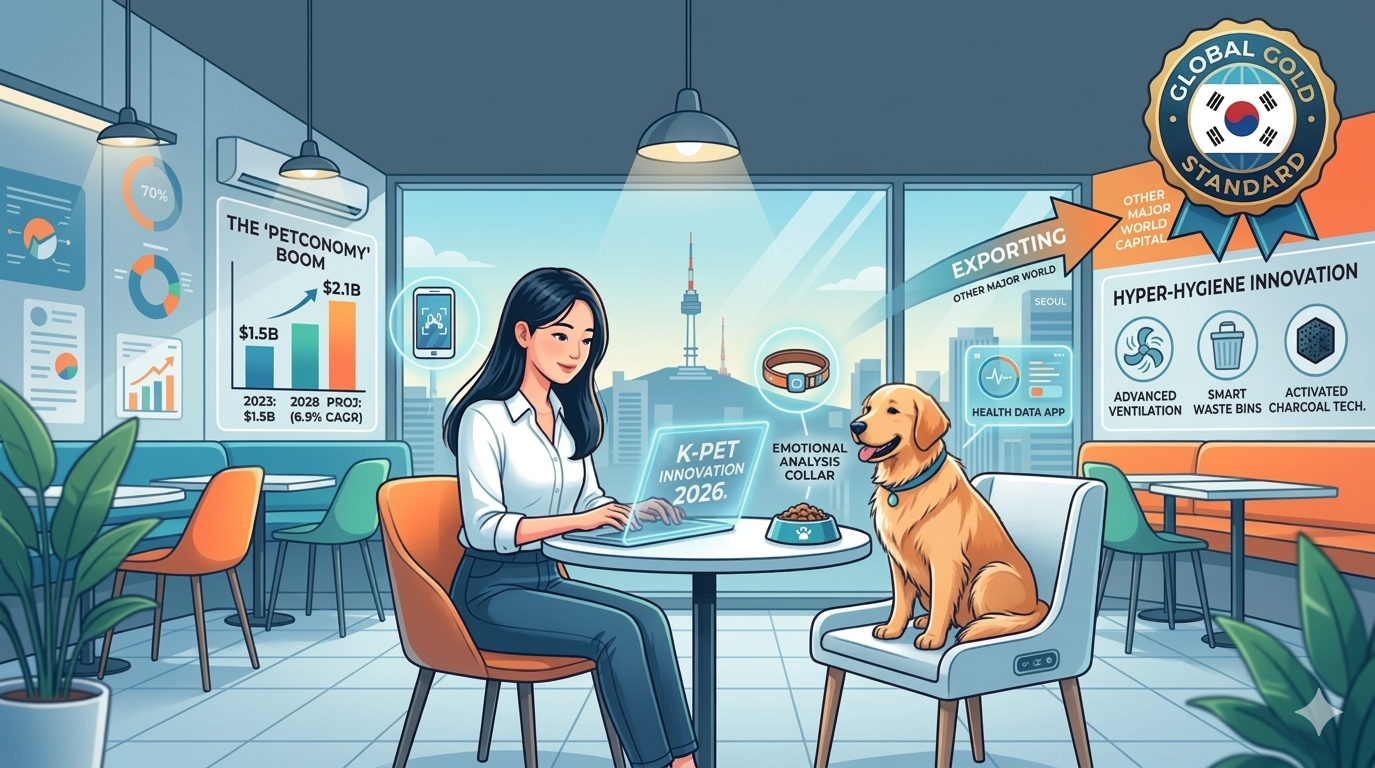
This isn’t just a win for animal lovers; it is the starting point for a multi-billion-dollar industrial evolution. As the barrier between “human space” and “animal space” dissolves, a new category of innovation has emerged: Hyper-Hygiene. Led by a wave of tech-forward startups, the South Korean “Petconomy” is no longer just about toys and kibble—it is about engineering a seamless, odorless, and “human-grade” co-existence that is now catching the eye of the global market.
From Companions to Co-habitants to Babies
To understand why the “K-Pet” trend is exploding, one must look at the numbers. South Korea has one of the lowest birth rates in the world. In the void left by a shrinking youth population, pets have moved from the porch to the pedestal.
Global Market Signals
The 2026 “Made in Korea” Gold Standard
Mobile Dominance
Korea leads the world in Direct-to-Consumer pet tech. 63% of total industry revenue is generated via e-commerce platforms like Coupang and Naver.
The Export Anchor
The “Made in Korea” label is now a high-signal trust marker. 2026 regulations have forced a level of traceability that US retailers increasingly demand over mass-produced alternatives.
Currently, nearly 3 in 10 (29.2%) South Korean households own a pet, representing an estimated 15.5 million people. This demographic shift has fundamentally altered spending habits. According to data from the Ministry of Agriculture, the average monthly spend per pet reached 142,000 KRW ($96) in 2025. However, for the “MZ Generation” (Millennials and Gen Z), that figure often exceeds 200,000 KRW when accounting for premium grooming and “pet-tech” subscriptions.
The “Humanization” Spending Surge
Evidence of pets transitioning to “Family Members” in South Korea (2023-2026).
PRE-2023 Baseline
2025 Average
Insight: Monthly Household Spend
Average South Korean households now spend 142,000 KRW ($96) monthly. Pet care is now a permanent, non-negotiable line item in family budgets.
Furthermore, the “humanization” of pets is most evident in medical spending. Annual veterinary costs in Korea surged from $412 in 2023 to $734 in 2025—a staggering 78% increase. When a pet is viewed as a child, price sensitivity disappears, and the demand for “Made in Korea” quality takes center stage.
The March 2026 Pivot: Regulation as a Catalyst for Innovation
The legalization of pets in dining areas has created a “hygiene stress test” for the industry. Under the new 2026 regulations, businesses must adhere to strict sanitary protocols. Some of these include physical barriers from food preparation areas, dedicated waste bins, and advanced ventilation.
This regulatory pressure has also forced startups to move beyond basic functionality. And, startup founders are aggressively leveraging this shift. One such Korean startup is a premium pet hygiene brand, WANSPAPA.
Do Hyoung Kim, the founder of WANSPAPA, notes that this specific friction is what drives their R&D.
“The new regulations… have fundamentally changed what Korean pet owners expect. When your dog sits at a table next to you, the bar for hygiene, odor control, and aesthetics shifts immediately. Products can no longer just ‘work,’ they have to meet human-grade standards in look, smell, and safety.”
Do Hyoung Kim, founder of WANSPAPA
WANSPAPA’s solution involves integrating activated charcoal technology—a staple in Korean traditional wellness and skincare—into pet waste management. By addressing odor at a molecular level rather than masking it with synthetic perfumes, they satisfy the “invisible hygiene” requirement of the 2026 dining laws.
The K-Pet Startup Ecosystem: More Than Just Supplies
The 2026 K-Pet boom is being led by three distinct tech pillars: AI-Diagnostics, Smart Wearables, and Bio-Materials.
1. AI-Driven Preventative Health
Startups like TTcare and Fitpet are capitalizing on the “pet-humanization” trend by reducing the friction of vet visits. TTcare uses AI-based smartphone scanning to detect early signs of eye and skin diseases. Fitpet offers at-home urinalysis kits provide real-time health data to a mobile app. In a market where pet-care medical costs are soaring, these “data-first” solutions are becoming household essentials.
2. The IoT “Emotional” Bridge
The loneliness of single-person households (which now make up over 30% of the Korean population) has fueled interest in pet communication. Startups such as Petpuls have gained international acclaim for AI-powered collars that analyze a dog’s bark to identify five distinct emotions. This isn’t just a novelty; it is a tool for the “pet parent” who views their animal’s emotional well-being as equal to their own.
3. Bio-Material Sophistication
Beyond WANSPAPA’s charcoal integration, there’s a surge in eco-conscious, traceable manufacturing. Korean consumers demand total transparency. Startups are now utilizing GRS (Global Recycled Standard) certified facilities and food-grade materials for everything from chew toys to waste bags.
“Made in Korea”: The New Global Gold Standard
Perhaps the most significant trend of 2026 is the rapid “export” of these Korean standards. This is not just limited to K-beauty or K-food, but is rapidly expanding to all sectors, including the pet industry. US and European pet retailers, once reliant on mass-produced, low-transparency imports, are pivoting toward Korean manufacturers.
The South Korean pet food and hygiene market is projected to reach $2.1 billion by 2028, growing at a CAGR of 6.9%. This growth isn’t just domestic; it is driven by a global appetite for the “K-Standard”—a blend of high-tech efficacy and aesthetic minimalism.
Daniel of WANSPAPA highlights a critical shift in the global supply chain. With his recent launch in the US market, he observed that buyers were less interested in the “cute” factor and more focused on the traceability and consistency of the Korean production line.
“Made in Korea has started to signal what ‘Made in Japan’ once did in electronics: precision, reliability, and a refusal to compromise on quality.”
Do Hyoung Kim, founder of WANSPAPA
The Seamless Future of Urban Living
The “K-Pet” trend of 2026 is a glimpse into the future of global urban living. As more cities worldwide grapple with aging populations and increasing urbanization, the “Korean Model”—high-density, pet-friendly, and tech-integrated—offers a blueprint for success.
The March 2026 regulations did more than just open the doors of cafes; they unlocked a new era of industrial design where pets are no longer treated as “other,” but as integrated members of the modern family. For founders, investors, and pet owners alike, the signal is clear: the future of pet care is human-grade, data-driven, and decidedly Korean.
Join us on an exciting journey to explore the vibrant world of Korean lifestyle – from the latest beauty tips to the hottest tech and so much more on Facebook, Twitter, LinkedIn, and Flipboard.