

The world’s largest R&D funding program was built for big labs. One Busan-based founder is changing that.
The world of high-stakes Research and Development (R&D) is notoriously insular. For years, the path to multi-million dollar grants has been a gauntlet of hundreds page compliance documents, tedious partner searches, and manual database scrubbing. For most researchers, the system is less a meritocracy and more an endurance test. Paul Conversy, the founder of InsightMatches, wants to tear down those barriers.
His answer is InsightMatches, an AI-powered platform that reimagines how researchers find funding, build teams, and submit proposals. Based in Busan, South Korea, it’s quietly positioning itself as the primary bridge between the Korean deep-tech scene and Horizon Europe — the €95 billion program that is the world’s largest R&D fund.
The Vision: Research for Everyone
While most people associate “research” with lab coats and clean rooms, Conversy sees a much broader horizon. “I think we have to think—anybody or most people could be a researcher,” he explains. He cites examples of museum curators seeking funds for digital kiosks or public school teachers developing textbooks on novel topics such as AI.
“We’re bringing down the barriers of research and making research more popular… it would be great to see some really creative, exciting projects from people you don’t expect, rather than the large research labs or universities.”
Paul Conversy, InsightMatches
InsightMatches isn’t just a search tool; it is a collaborative ecosystem designed to accelerate the “tedious and broken” system of international grant applications.
Transforming the “Broken” Grant System
Having worked on European projects for years, Conversy observed firsthand that the traditional R&D funding system was inefficient. “This system is very broken,” he notes, highlighting that the problem persists across every sector, from health to tech to climate solutions.
For the average researcher, manually searching for funds and drafting 15-page proposals is incredibly tedious and time-consuming.
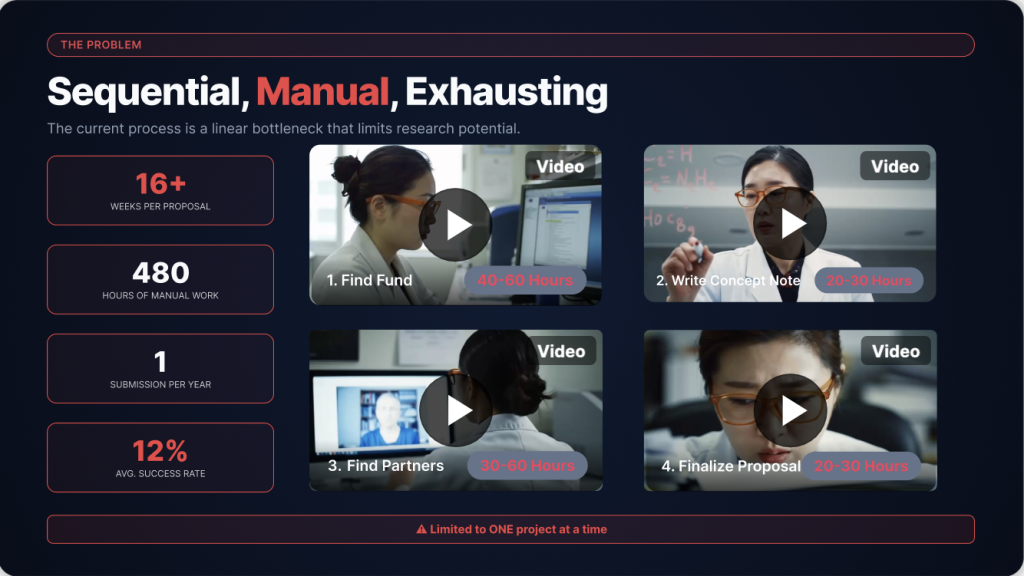
Q: How does InsightMatches make it easier for a researcher who is overwhelmed by data?
Paul Conversy: The platform uses a patented visualization method to help users cut through the noise and identify viable funds quickly. Each fund appears as a node — color-coded red for a poor fit, orange for marginal, and green for a strong match. Position indicates deadline, size reflects budget, so you can read the landscape at a glance.
Once you select a fund, the platform generates project ideas tailored to that specific call, suggesting what you could write, and showing how your profile aligns with what the funder is looking for. There’s also a card view where you can move through opportunities one by one, selecting or dismissing them in seconds. The AI is doing the heavy lifting, but you stay in control throughout.
From there, the platform recommends team members whose expertise fits the project. It connects you with the right collaborators across disciplines and geographies. It then outputs the technical documents and submission templates you need to actually apply. The goal is to take you from discovery all the way to a submission-ready package, without losing the researcher’s judgment at any step.
Lowering the Barrier to Entry
A core philosophy of InsightMatches is that research should be accessible to more than just those in “lab coats”. Conversy envisions a world where even a local school teacher or a museum curator can lead research projects. “We’re bringing down the barriers of research… we’re aiming to make research more popular,” he explains.
The platform doesn’t just find money; it builds teams. Because modern R&D projects are highly collaborative—often requiring dozens of partners like lawyers, software engineers, and specialists working together—InsightMatches includes an “invitation hub” that suggests potential partners and allows users to manage collaborations within the app.
The “Researcher DNA” and Data Security
One of the most innovative features of InsightMatches is what Conversy calls “Researcher DNA.” The platform builds a profile based on a researcher’s history and data, which the AI then uses to suggest the perfect collaborators.
“We’re not claiming to replace the process 100%. Obviously, once you’ve outputted your draft project, you still need to review”.
Paul Conversy, InsightMatches
However, in an era of AI “hallucinations” and data leaks, Conversy remains grounded. “We abide by the GDPR [General Data Protection Regulation],” he notes, emphasizing that the platform is built for the strict European legal framework.
“The AI might make some assumptions in good faith, which might not be accurate. There’s still a review element to be made by the researcher… The AI will not access the original research data of others; it will access a very broad summary to understand who you should work with.”
The Strategic Value of Horizon Europe
The timing is critical as South Korea recently became the first Asian country to join Horizon Europe as an associated country. Conversy views this as a major “door for easier entry into Europe” for Korean deep-tech startups. Beyond the grant money itself, participating in these projects allows Korean firms to build vital networks and attend team meetings across Europe. It makes future business expansion much smoother.
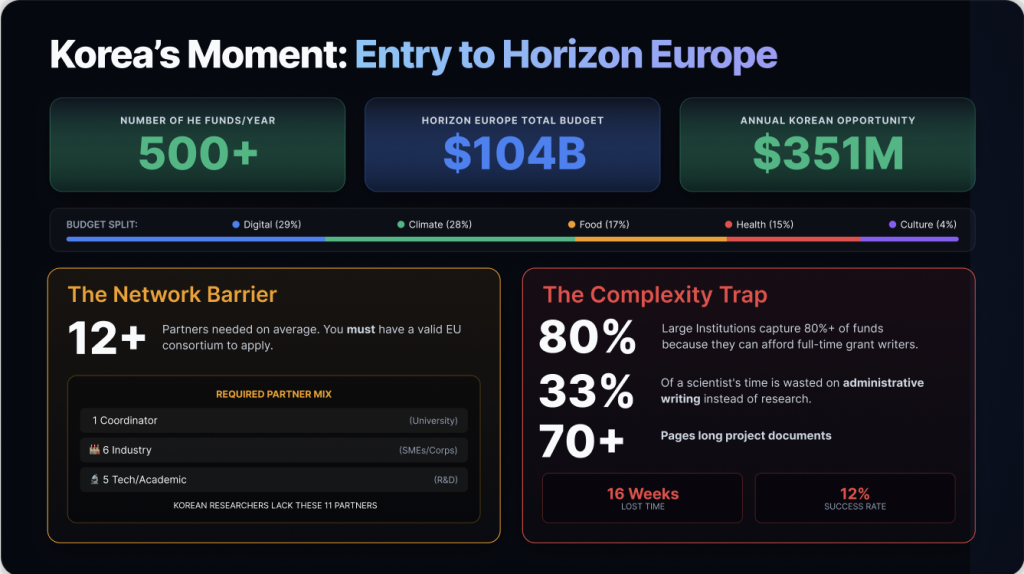
Q: Many Korean startups aim for the US. Why should they look toward Europe instead?
Paul Conversy: Horizon Europe grants mean a steady income for the next few years. But beyond the money, it’s a door for easier entry into Europe. If you’re a Korean hydrogen startup working on a project in Southampton, UK, you’ll know all the key players there. When you eventually want to do business there, it’s a much smoother, more realistic prospect because you already have the network.
Choosing Busan Over Seoul
While most startups gravitate toward Seoul, Conversy intentionally based InsightMatches in Busan. He cites the city’s high quality of life and its proximity to major industrial R&D bases, such as the defense industry in Changwon and Hyundai in Ulsan, as strategic advantages. “Busan is also a much nicer place to live… you can get anywhere here in around 30 minutes, you can go to any part of the city, and you’ve got the beach and the mountain,” he shares.
Strategy and Scale: The 130x ROI
InsightMatches is moving fast. Conversy has already signed MOUs with organizations representing 6,000 researchers, including the African research organization WARESA and deep-tech accelerators like Bliss Vine Ventures.
The business model is built on high-signal value. Conversy plans an annual subscription of 3.6 million won. Given that the average grant size is roughly 500 million won, he estimates a return on investment (ROI) for his customers of at least 130 times the subscription cost.
Looking Toward 2030
For Conversy, success by 2030 isn’t just about being a software provider; it’s about being a key player in making global connections for research. InsightMatches aims to be the architect of a new, more efficient global research infrastructure.
His message to investors is clear: the field of R&D is only going to grow as economies become more advanced and globalized.
“We’re shaping the future of it by heavily leveraging AI and creating a platform where the users… are all pushing and helping each other to get more opportunities.”
Paul Conversy, InsightMatches
Key Takeaways
- Democratizing Global R&D — Opens the door to funding for non-traditional actors — teachers, curators, small enterprises — who would otherwise never navigate the complexity of programs like Horizon Europe
- From Discovery to Submission in One Platform — A patented node-based visualization (color-coded by fit, sized by budget, positioned by deadline) surfaces the right opportunities instantly; a card-swipe interface — think Tinder for grants — lets users move through options in seconds
- End-to-End Project Assembly — Once a fund is selected, the platform generates tailored project ideas, recommends cross-disciplinary team members, and produces the technical documents and submission templates needed to apply
- “Researcher DNA” Matching — AI-built profiles connect the right collaborators across sectors and borders while operating fully within GDPR compliance
- Strategic EU-Korea Gateway — Capitalizes on South Korea’s new associated-country status in Horizon Europe to give Korean deep-tech startups a structured, relationship-first route into European markets
- 130x ROI Signal — At 3.6 million KRW per year, the subscription targets grants averaging 500 million KRW — a return multiple that makes the platform easy to justify
- Proposal Scoring Before Submission — An AI evaluation module scores draft proposals ahead of official deadlines, helping teams course-correct before it matters
- The Busan Advantage — Proximity to South Korea’s industrial R&D spine — Changwon’s defense sector, Hyundai’s Ulsan hub — positions InsightMatches where the projects actually are
Company Snapshot
| Feature | Details |
| Company Name | InsightMatches |
| Founder | Paul Conversy |
| Headquarters | Busan, South Korea |
| Founded | Q2 2025 |
| Core Product | AI-driven R&D grant discovery, team assembly, and proposal platform |
| Primary Market | South Korea and EU (Horizon Europe) |
| Key Metric | ~130x ROI with an average grant size of 500M KRW |
| Pricing Model | Annual subscription of 3.6 million KRW |
| Website | https://www.insightmatches.com |
Join us on an exciting journey to explore the vibrant world of Korean lifestyle – from the latest beauty tips to the hottest tech and so much more on Facebook, Twitter, LinkedIn, and Flipboard.