

TL;DR: The 2026 K-Beauty Power Shift
In 2026, the real power in beauty isn’t the brand name on the bottle—it’s the factory that made it. Korean manufacturing giants like Cosmax and Kolmar Korea (the “2 Trillion Won Club”) have become the “TSMC of Beauty,” providing the high-tech infrastructure for everyone from Amazon to indie influencers. The “Marketing Moat” is dead; the new “Alpha” is owning the formulas and the AI-driven smart factories that can produce them at scale.
By 2026, the real power in K-beauty has moved away from famous brand names and shifted entirely to the “foundry” layer of manufacturers (ODMs). This change is clear in the numbers: in 2025, Cosmax hit a record 2.39 trillion KRW in revenue, while Kolmar Korea reached 2.72 trillion KRW. These giants have become the essential backbone of the industry.
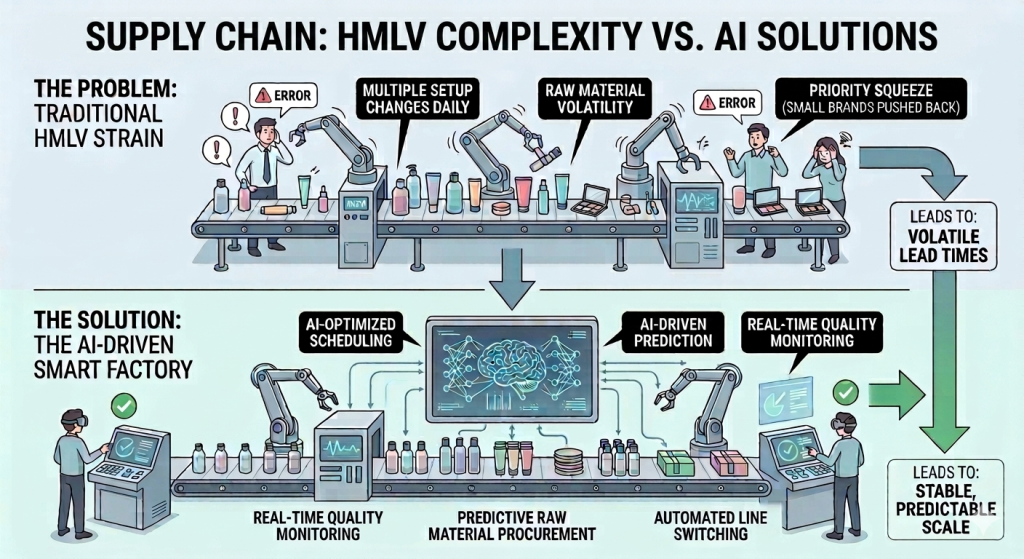
In this new landscape, big advertising budgets are no longer enough to win. Instead, the real advantage comes from owning the chemical formulas and using AI-driven smart factories to produce many different types of products in smaller batches. Much like the semiconductor industry relies on TSMC to make chips, the global beauty industry now relies on these Korean manufacturers as its indispensable high-tech engine.
The New Giants: 2 Trillion Won in Revenue
The Korean cosmetics industry now works like the global semiconductor market. Just as TSMC makes the chips for the world’s biggest tech companies, Korean manufacturers (ODMs) now provide the “brains” for the global beauty sector.Because these factories are so advanced, a brand’s success is no longer based on how much it spends on marketing, but on the technical formulas and “Smart Factory” technology it can access in Korea.
The Manufacturing Infrastructure Pivot
The value in K-beauty has migrated from the creative front-end to the technological back-end. With Cosmax and Kolmar reporting massive growth and high profit margins, it is clear that being the “maker” is now more profitable than being the “seller.” The industry has pivoted to a model where the infrastructure itself is the primary competitive advantage.
Cosmax reported a record high revenue of 2.39 trillion KRW in 2025, representing a ten percent year-on-year increase that validates this trend. Similarly, Kolmar Korea surpassed 2.72 trillion KRW in revenue, with its domestic business achieving an operating margin of nearly 14 percent. Fundamentally, these figures indicate that the “Value Add” in K-beauty has migrated from the creative front-end to the technological back-end.
The “Big 4” Performance Table (FY 2025)
| Company | 2025 Revenue (KRW) | Growth (YoY) | Operating Profit | Specialization |
| Kolmar Korea | 2.72 Trillion | +11.0% | 239.6 Billion | Sun care (70% market share) & Skincare |
| Cosmax | 2.40 Trillion | +10.7% | 195.8 Billion | Color Cosmetics & Global Export |
| Cosmecca Korea | 640.6 Billion | +22.2% | 83.4 Billion | Skincare (60% of production) |
| C&C International | ~300+ Billion | Variable | ~30+ Billion | Premium Lip & Eye (Color) |
Gemini said
Here is the performance data for the “Big 4” Korean manufacturers, which explains why they are considered the new “Alpha” of the industry.
The “Big 4” Performance Table (FY 2025)
| Company | 2025 Revenue (KRW) | Growth (YoY) | Operating Profit | Specialization |
| Kolmar Korea | 2.72 Trillion | +11.0% | 239.6 Billion | Sun care (70% market share) & Skincare |
| Cosmax | 2.40 Trillion | +10.7% | 195.8 Billion | Color Cosmetics & Global Export |
| Cosmecca Korea | 640.6 Billion | +22.2% | 83.4 Billion | Skincare (60% of production) |
| C&C International | ~300+ Billion | Variable | ~30+ Billion | Premium Lip & Eye (Color) |
Why These Numbers Matter
- Scale: For the first time, both Cosmax and Kolmar have firmly established themselves in the 2 Trillion Won Club, making them larger than many of the brands they actually manufacture for.
- Indie Brand Surge: These record profits were driven primarily by the global success of “Indie” brands (like Beauty of Joseon or Anua), which rely 100% on these factories for their science and production.
- Global Expansion: Kolmar’s growth was supported by its massive 71% increase in U.S. subsidiary sales, while Cosmax focused on high-growth regions like Southeast Asia and its new foothold in Italy.
The Commoditization of Brand Identity
Korean manufacturers have made it so easy to create a beauty line that brand identity has become a commodity. Today, a global retailer like Amazon or Sephora can develop and launch an entire product line in Seoul without ever needing a traditional brand partner. While this is efficient, it has led to a crowded market where many products feel interchangeable because they are all coming from the same few high-powered factories.
The Death of the Marketing Moat
In the past, big beauty companies were protected by massive advertising budgets that smaller players couldn’t afford. However, the 2026 ODM model has democratized the industry. Now, a single influencer or a small startup can access the same world-class formulas as a luxury conglomerate. This has fueled a surge in exports to the US, as these “indie” brands can now compete on quality without needing a massive corporate machine behind them.
The High-Tech Struggle Behind the Scenes
Despite the success, this new era is under a lot of pressure. The industry has moved toward “High-Mix Low-Volume” production, meaning factories have to constantly switch their setups to handle many different small orders. This creates friction, as lead times for raw materials become unpredictable and global supply chain issues can cause immediate bottlenecks in Seoul.
Operating Under Extreme Operational Strain
Specifically, current market demand requires ODMs to switch manufacturing setups multiple times per day to accommodate a vast array of indie brand orders. Resultantly, lead times for raw materials have become increasingly volatile, with specialized peptides and eco-friendly packaging components facing frequent delays. Moreover, the absolute dependence on global raw material supply chains means that any geopolitical disruption triggers immediate production bottlenecks in Seoul.
AI-Driven Smart Factories and Localized Production
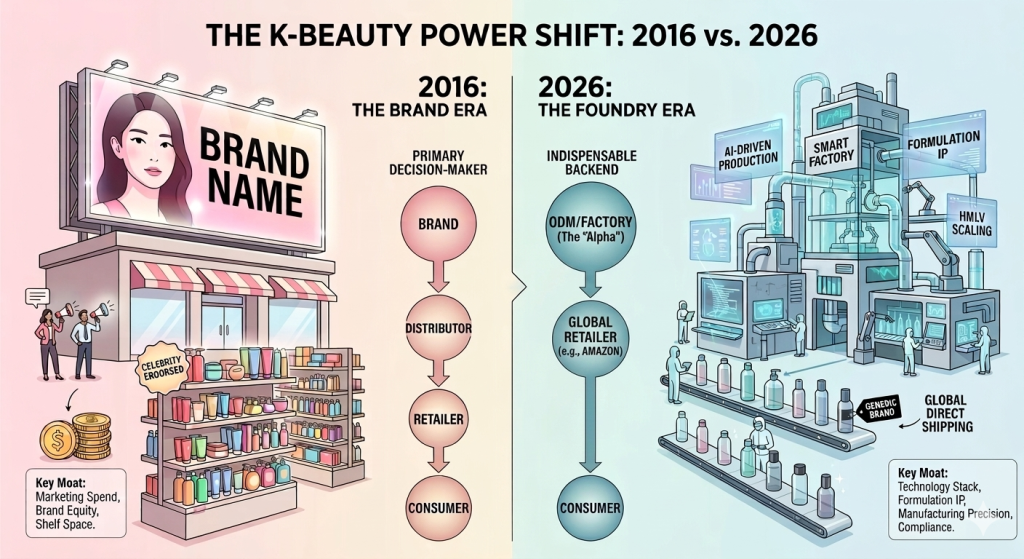
Nevertheless, Korean manufacturing giants are pivoting toward AI-driven “Smart Factories” to mitigate these structural weaknesses. Cosmax is tripling its production capacity in Thailand by 2026 to serve as a regional hub for Southeast Asian supply chain stability. Similarly, Kolmar Korea expanded its US presence with a second facility in Pennsylvania, targeting an annual output of 300 million units.
These smart factories help reduce shipping delays and help companies stay compliant with strict new safety laws, like the US MoCRA regulations, which have made production more expensive and complex.
Navigating the Priority Squeeze and Relationship-Based Procurement
Because these factories are so busy, a “Priority Squeeze” often happens. When a giant retailer like Sephora places a huge order, smaller brands often find their production delayed. In this environment, success depends on having a strong relationship with the factory managers. Getting your products made is no longer just a simple transaction; it’s a competition for factory space.
The Pivot: Why Retailers are Skipping the Middleman
Sourcing Strategies for the Infrastructure-First Horizon
The future strategy for global buyers is “Infrastructure-First.” We expect to see more retailers launching their own private labels by working directly with Korean factories. Traditional distributors who just move products from point A to point B are facing a “pivot or perish” moment, as the industry moves toward direct-to-factory agreements to save money and increase speed.
Amazon’s “K-Beauty Success Roadmap,” launched in collaboration with Kolmar Korea, provides a definitive template for this structural transition. Specifically, this initiative allows Amazon to curate high-performance products directly for its global customer base, bypassing the traditional brand acquisition phase.
Investment Alpha in the Cosmetics Technology Stack
For investors, the real opportunity is no longer in the labels on the bottles, but in the technology used to make them. As basic skincare becomes a commodity, the market is moving toward “clinical-grade” products and longevity-focused science. The next big battlefield will be the convergence of biotechnology and beauty.
Regulatory Rigor and the Mandatory Compliance Metric
As laws get stricter in 2026, being able to follow the rules has become a key business metric. New policies like Korea’s “Jump-up K-Cosmetic 2026” enforce very high quality standards. Companies that can’t keep up with these safety and reporting costs will likely be forced out of the market by 2027, leaving only the most professional and compliant players standing.
The Permanent Structural Reality of Beauty Infrastructure
The “Foundry” era isn’t just a temporary trend; it is a permanent change in how the beauty world works. By adopting the high-tech model used by the tech industry, South Korea has made itself the indispensable engine of global cosmetic innovation. To succeed in 2026 and beyond, companies must view Korea as the essential infrastructure for everything they build.
Join us on an exciting journey to explore the vibrant world of Korean lifestyle – from the latest beauty tips to the hottest tech and so much more on Facebook, Twitter, LinkedIn, and Flipboard.