
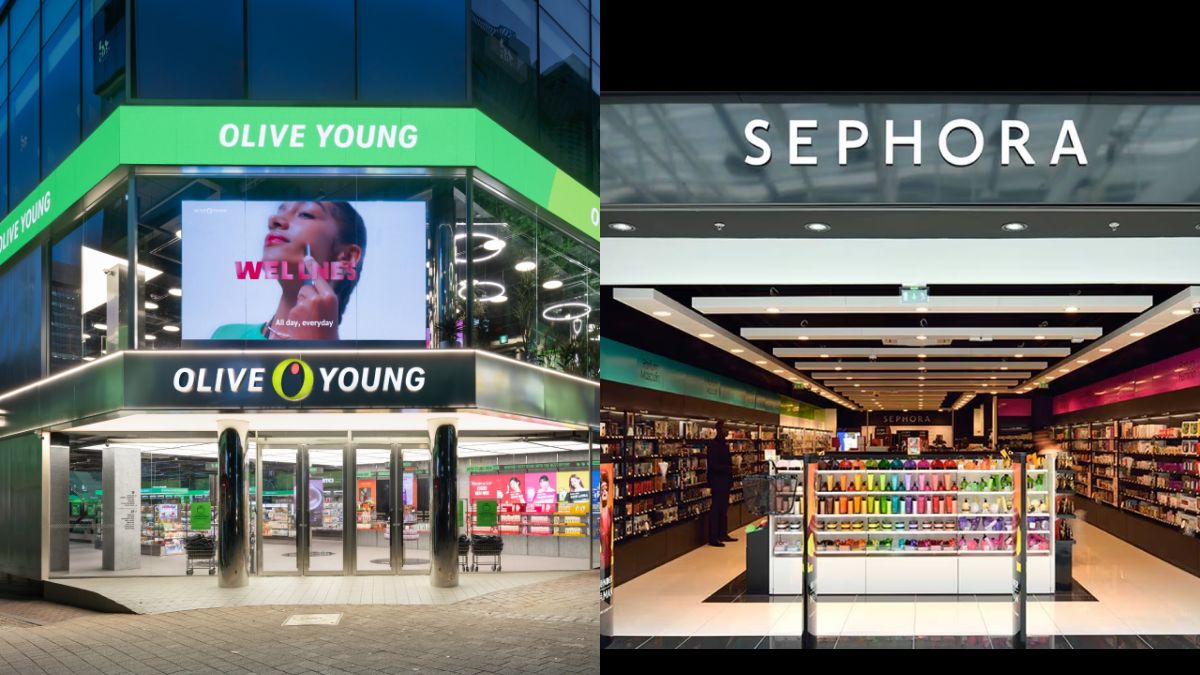
Sephora and CJ Olive Young partnership signals a strategic shift in global beauty retail and how Korean brands scale internationally.
Sephora has announced a strategic partnership with CJ Olive Young, South Korea’s dominant beauty and wellness retailer, marking a significant shift in how Korean beauty brands are positioned within global retail markets. Rather than expanding independently in Korea or relying on ad-hoc brand imports, the LVMH-owned beauty chain is now turning to a local powerhouse to accelerate K-beauty’s integration into its global ecosystem.
The partnership reflects broader structural changes in the beauty industry: rising demand for Korean skincare, increasing competition in mature Western markets, and a growing recognition that local retail expertise is critical to global scale.
Why Sephora Partnered With CJ Olive Young
At its core, the Sephora–Olive Young partnership is a strategic response to market realities rather than a simple merchandising collaboration.
Under the agreement, Sephora will introduce Olive Young–curated K-beauty assortments across its omnichannel platforms in key regions, beginning with the United States, Canada, Hong Kong, and Southeast Asia in 2026, followed by expansion into the UK, Australia, and the Middle East in 2027.
This approach allows Sephora to tap directly into Olive Young’s strengths: trend forecasting, rapid product rotation, and data-driven curation. It also reflects lessons learned from Sephora’s own experience in Korea. After entering the Korean market in 2019, Sephora exited in 2024, unable to compete with Olive Young’s deeply embedded retail model and local consumer insight.
The partnership marks a pivot from competition to collaboration.
K-Beauty’s Shift From Trend to Core Category
K-beauty’s global trajectory has changed materially over the past decade. Once viewed as a trend-driven niche, Korean beauty is now embedded in mainstream skincare routines worldwide.
South Korea currently ranks as the fourth-largest cosmetics exporter globally, supported by strong demand for functional skincare, innovative formulations, and competitive pricing. At the same time, Sephora operates more than 3,400 stores across 35 countries, giving it unmatched reach for category expansion.
By aligning with Olive Young, Sephora is effectively formalizing K-beauty’s transition from “imported trend” to core global retail category — one curated not by individual brands, but by an ecosystem architect.
Sephora’s Korea Strategy: From Market Entry to Global Partnership
Timeline showing Sephora’s strategic shift from direct competition in South Korea to collaboration with CJ Olive Young for global K-beauty expansion.
Sephora enters the South Korean market, launching its first flagship store in Seoul to compete directly with local multi-brand retailers.
Following sustained operational losses and a high-barrier competitive landscape, Sephora winds down all offline and online retail presence in Korea.
Sephora pivots to a partnership model with CJ Olive Young, establishing “K-beauty zones” within Sephora’s global store network and digital platforms.
Official launch of Olive Young–curated zones across high-growth markets including the U.S., Canada, Hong Kong, Singapore, Malaysia, and Thailand.
Strategy expands to incorporate secondary tiers including the Middle East, UK, and Australia, solidifying K-beauty as a permanent pillar of Sephora’s global offering.
How the Partnership Changes Global Beauty Retail Strategy
United States: From Discovery to Standardization
In the US, where Sephora plays a central role in beauty discovery, the partnership signals a move toward standardized K-beauty placement rather than sporadic brand launches. Olive Young’s curation model offers a framework for organizing Korean products by function and trend, not just brand equity — a notable shift in merchandising logic.
Southeast Asia: Formalizing Existing Demand
In Southeast Asia, where K-beauty already benefits from cultural proximity and digital influence, the partnership formalizes demand that has largely grown organically. The move allows Sephora to consolidate fragmented consumer interest into a scalable retail strategy.
Middle East: Targeting Premium Skincare Growth
The planned Middle East expansion reflects rising premium skincare consumption in the region. Historically underserved by Korean brands at scale, these markets present an opportunity for Sephora to introduce K-beauty through a trusted, curated framework rather than direct brand entry.
Why Olive Young Holds Strategic Leverage
Founded in 1999, CJ Olive Young operates over 1,390 stores across South Korea and functions as the country’s primary beauty trend incubator. Its retail model prioritizes category-led discovery, rapid turnover, and data-informed merchandising — a stark contrast to traditional brand-dominated layouts.
This approach has proven influential enough to be studied as a retail innovation case. It underscores Olive Young’s role not just as a retailer, but as a market-shaping platform.
For Sephora, partnering with Olive Young offers access to:
- Proven trend validation mechanisms
- Early exposure to emerging Korean brands
- A scalable curation system adaptable across regions
What This Means for Korean Beauty Brands
For Korean brands — particularly small and mid-sized players — the partnership offers something historically difficult to achieve: structured global distribution without independent market entry.
Instead of navigating fragmented overseas retail landscapes, brands can potentially scale through Sephora’s infrastructure. They will also be benefiting from Olive Young’s selection credibility. This lowers barriers to entry while increasing competition within curated assortments.
However, inclusion is not guaranteed. Olive Young’s data-driven model favors performance and consumer response, meaning global exposure will likely be selective, not universal.
A Broader Shift in Global Retail Thinking
The Sephora–Olive Young partnership illustrates a broader transformation in international retail strategy:
- Localization through partnership, not replication
- Curation over brand dominance
- Data-informed expansion instead of market-by-market experimentation
For global retailers, the takeaway is clear: entering culturally complex markets — or scaling products born within them — increasingly requires embedded local intelligence rather than top-down global models.
Final Takeaway
This partnership is less about adding Korean brands to shelves and more about rewiring how global beauty retail operates. By aligning with CJ Olive Young, Sephora is acknowledging that the future of beauty expansion lies not in exporting formats, but in importing expertise.
As K-beauty continues its evolution from trend cycle to global standard, collaborations like this may become the rule rather than the exception — reshaping how beauty products move from local success to international scale.
Join us on an exciting journey to explore the vibrant world of Korean lifestyle – from the latest beauty tips to the hottest tech and so much more on Facebook, Twitter, LinkedIn, and Flipboard.