

Explore why the success of K-beauty in Europe is shifting from viral TikTok trends to data-backed retail intelligence and the cost of virality.
The era of the viral overnight success in the beauty industry is hitting a plateau. While a 15-second TikTok clip can still empty shelves in forty-eight hours, the brands that are actually staying on those shelves in 2026 are playing a much more calculated game.
In Europe, the K-Beauty landscape has shifted. We are moving away from the “novelty” phase, where a product was bought simply because it was Korean. Now in a “maturity” phase, product is bought because it solves a specific problem backed by hard numbers. For founders and investors, the focus has moved from chasing the next “snail mucin” moment to building a “data-backed bridge” that can survive the complex retail reality of the European market.
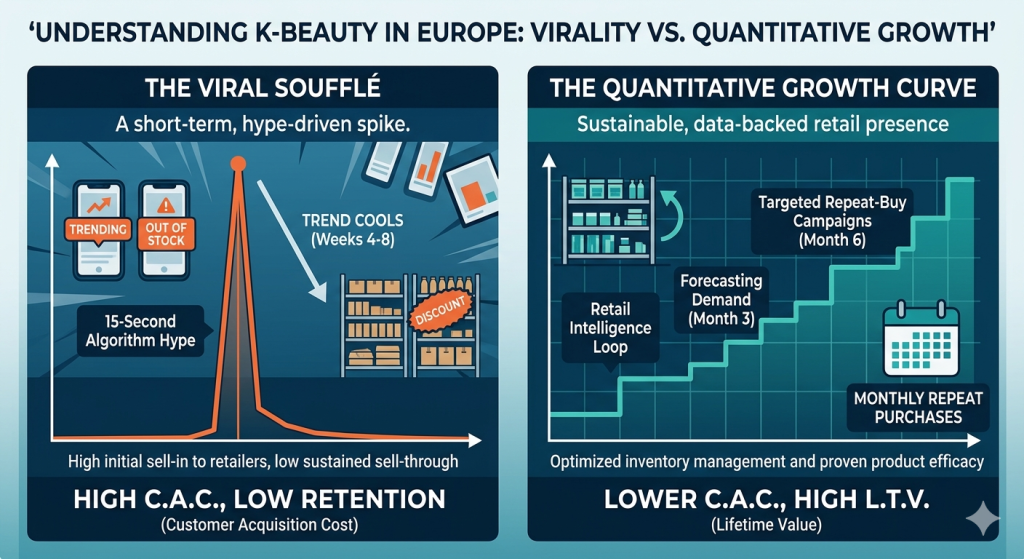
The Cost of the “Soufflé” Effect
For years, virality was the holy grail. But as the market matures, the industry is realizing that virality often behaves like a soufflé. It rises impressively fast but collapses the moment the heat of the algorithm moves elsewhere.
The primary reason for this shift is the skyrocketing cost of doing business. According to market analysis by PwC, competition in the beauty sector has intensified to the point where “weaker or subscale brands” are under immense pressure. In a world where Customer Acquisition Cost (CAC) is at an all-time high, a one-off viral spike isn’t enough to sustain a business. You need repeat customers, and repeat customers come from a product that earns its place in a daily routine through proven efficacy, not just a trendy aesthetic.
The Paradox of the “Asymmetric Trend”
One of the most fascinating developments in 2026 is the disconnect between what’s popular in Seoul and what wins in Europe. We often assume that a trend travels in a straight line from East to West, but the reality is far more asymmetric.
Some of the biggest names in the European K-Beauty space are, ironically, not the ones leading in South Korea. This “Asymmetric Trend” highlights a crucial lesson for distributors: a brand’s success is determined by how well it adapts to the specific skin concerns and lifestyle habits of the local consumer, rather than its domestic fame.
Hana Tolio, Co-founder and CMO of BAEKHO BEAUTY TRADING, has observed this firsthand while building the retail bridge between these two distinct markets.
“It’s very complicated. Because what’s trendy in Korea, may not be trendy with the overall consumer of K-Beauty in Europe. For example Beauty of Joseon has been a best seller in Europe, everywhere, for some years now. But, they are not a renown name in Korea (the group is though).”
Hana Tolio, Co-founder and CMO of BAEKHO BEAUTY TRADING
This insight is backed by recent export data showing that South Korea’s cosmetics exports reached a record $11.43 billion in 2025. A significant portion of that growth comes from “Global-First” brands like Beauty of Joseon. They have surpassed legacy giants in market capitalization by focusing on international demand.
Navigating the Regulatory and Cultural Friction
The bridge between Seoul and Europe isn’t just about marketing; it’s a grueling logistical and regulatory hurdle. Europe maintains some of the most stringent cosmetic safety standards in the world. As recent industry guides point out, the EU’s CPNP registration and the requirement for a “Responsible Person” create a significant timeline lag.
Seoul’s product cycle moves at lightning speed, often launching new iterations in weeks. On the other hand, Europe’s regulatory and retail cycles are much more conservative. This creates a friction point that hype alone cannot fix for K-beauty brands in Europe.
Hana explains that managing this friction is the core challenge for modern distributors:
“Data backed needs to have growth, the virality can be like a soufflé, it goes high up; then goes down. Quantitative Data is what brands need to aim for, especially since it costs SO MUCH to onboard new clients these days.”
Hana Tolio, Co-founder and CMO of BAEKHO BEAUTY TRADING
Quantitative Intelligence vs. The Algorithm
As we look toward the remainder of 2026, the brands winning the “sell-through” battle are those using Quantitative Data to predict inventory needs and consumer shifts months in advance. The European market is currently valued at over US$21 billion for K-Beauty products, but that revenue is increasingly concentrated in brands that treat distribution as a science.
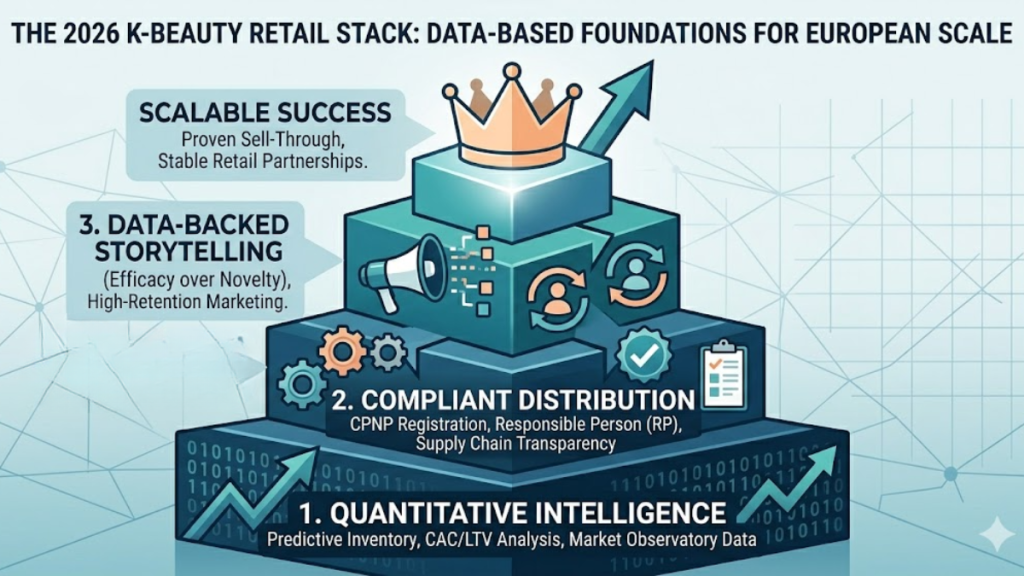
Data-driven distribution allows K-beauty brands in Europe to:
- Lower the “Soufflé” Risk: By using predictive analytics to ensure they aren’t overstocked when a trend cools.
- Optimize Retail Space: Proving to European buyers that a product has a sustained growth curve, justifying its real estate on the shelf.
- Counteract High CAC: By identifying high-retention customer segments that offer a better Lifetime Value (LTV) than the one-click viral buyer.
The takeaway for the industry is clear: the era of guesswork is over. In a crowded, expensive, and highly regulated European market, the only way to build a brand that lasts is to trade the temporary high of the algorithm for the long-term stability of the spreadsheet. As the market continues to diversify into 2026, the winners won’t be the ones with the most views, but the ones with the best data.
Join us on an exciting journey to explore the vibrant world of Korean lifestyle – from the latest beauty tips to the hottest tech and so much more on Facebook, Twitter, LinkedIn, and Flipboard.