
The landscape of South Korean beauty exports is undergoing a fundamental structural change this month. As of April 2026, the Ministry of Food and Drug Safety (MFDS) has moved beyond simple oversight, initiating a legislative cycle that prioritizes digital transparency and rigorous safety data. For Direct-to-Consumer (D2C) brands, these changes are not just administrative hurdles—they are the new infrastructure for global scaling.
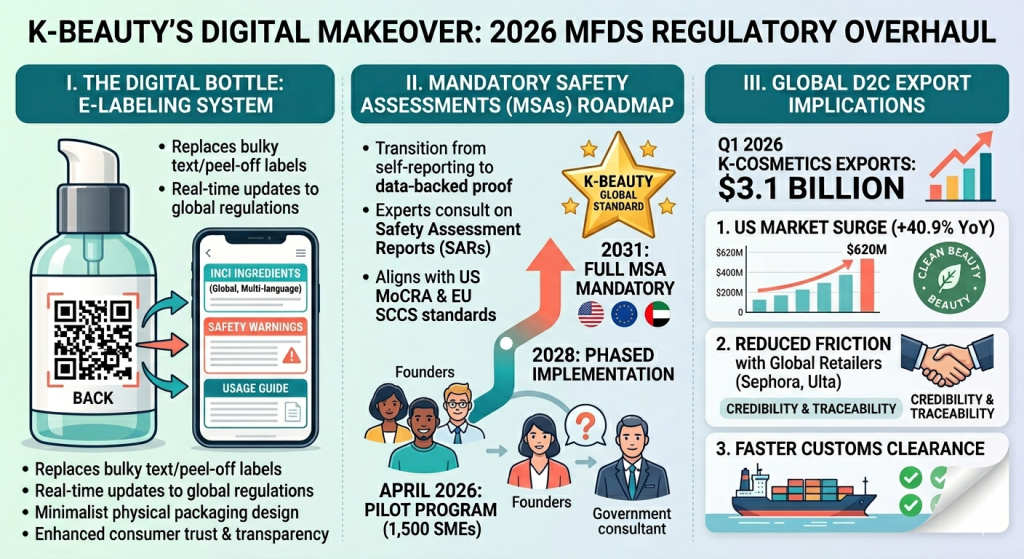
This transformation comes at a moment of unprecedented global demand. According to the latest figures released on April 6, 2026, by the Ministry of Food and Drug Safety, cosmetics exports reached a record-breaking $3.1 billion in the first quarter of 2026, a 19% increase compared to the previous year. With the United States now serving as the top destination—accounting for roughly $620 million of that total—the push for digital regulatory alignment is more urgent than ever.
The Rise of the “Cosmetic Safety Assessment” Era
The most critical shift this month is the formal launch of the Cosmetic Safety Assessment Support Program. Officially announced on April 1, 2026, this program is designed to transition the industry toward a mandatory safety assessment system similar to the European Union’s SCCS standards.
Historically, Korean beauty brands operated under a post-market surveillance and self-reporting system. However, the MFDS is now laying the groundwork for a new system. The safety of a product must be scientifically proven before it hits the shelf. By offering expert consulting to 1,500 small and medium-sized enterprises (SMEs)—specifically those with an annual output value of less than KRW 1 billion—the government is attempting to bridge the technical gap for smaller D2C players.
The roadmap is clear: while the full mandatory system is scheduled for phased roll-out between 2028 and 2031, the 2026 legislative cycle is establishing the “Cosmetics Safety Information Center” as the primary digital gateway for all export verification. Brands that participate in the current application window (open through April 30, 2026) will gain a significant first-mover advantage in data-readiness.
Inside the Transition: The Startup Perspective
For innovative startups like Lillycover, which specializes in hyper-personalized, real-time formulation, the MFDS program represents an opportunity to solve unique regulatory puzzles. SunHee An, founder of Lillycover, views the program as a way to formalize safety validation for a brand-new category of beauty.
“Rather than addressing a fundamental gap, we see this as an opportunity to further systematize and formalize safety validation in the context of hyper-personalized cosmetics,” An explains. “Our solution operates on on-demand formulation, where each product is customized in real time. This creates a unique regulatory challenge compared to traditional mass-produced cosmetics.”
SunHee An, founder Lillycover
For Lillycover, the focus is on strengthening the framework for validating active ingredient combinations in small-batch production and ensuring alignment with global standards like the US MoCRA and EU CPNP.
E-Labeling: Digital Solutions for Global Inventory
One of the biggest pain points for D2C brands has been the physical real estate on a product bottle. Managing different ingredient lists for the US, EU, and Southeast Asia often means maintaining multiple inventories. Or, the other option is to use cluttered, multi-fold labels that detract from a brand’s aesthetic.
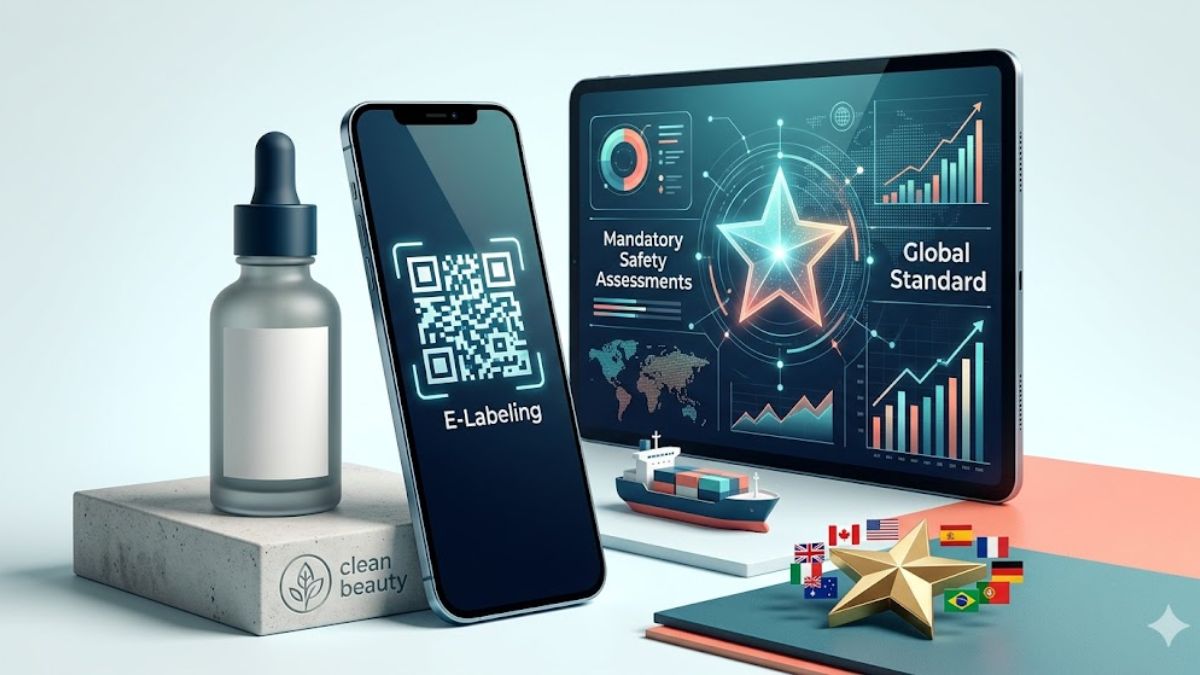
In April 2026, the Institutionalization of E-Labeling has reached a fever pitch. The MFDS is formalizing a system where a standardized QR code on the primary packaging replaces traditional long-form text. For a D2C brand shipping from Seoul to New York or Dubai, this means a single, minimalist packaging design can serve all markets simultaneously.
The digital nature of these labels allows for real-time updates. If a regulation changes in a specific target market—such as the recent restriction of the UV filter Phenylene Bis-Diphenyltriazine to a 5% maximum concentration—the brand can update the digital landing page instantly. This eliminates the need to recall or reprint physical boxes, providing a level of logistical agility that was previously impossible.
Why Digital Transparency is the New Export Currency
The move toward digital labeling and mandatory safety assessments is a direct response to the “K-Beauty boom” in high-regulation markets.
“Standardized safety validation builds trust—not only with regulators, but also with global partners and consumers,” says An. “For companies like Lillycover, which have already invested heavily in data infrastructure, this transition is relatively manageable. In fact, it may serve as a barrier to entry, favoring companies with strong technological and operational foundations.”
This credibility is essential when dealing with global giants. Major Western retailers like Sephora or Ulta prioritize traceability and regulatory transparency. Having government-backed validation reduces friction in these high-stakes discussions and positions Korean startups as trusted infrastructure providers, not just product manufacturers.
While exports to China decreased by 9.6% in the first quarter, the explosive 40.9% year-on-year growth in the US market has changed the priority for Korean regulators.
By institutionalizing these requirements at home, the MFDS is effectively “pre-clearing” Korean products for global compliance. The new Cosmetic Safety Information Center acts as a technical hub where brands can verify formulations against diverse global standards, such as the US MoCRA (Modernization of Cosmetics Regulation Act).
For investors and founders, these updates prove that K-Beauty’s future rests on safety data, not just trends. As the MFDS aligns with strict global standards, Korean beauty and cosmetics brands are becoming the most compliant and transparent leaders in the prestige market.
Join us on an exciting journey to explore the vibrant world of Korean lifestyle – from the latest beauty tips to the hottest tech and so much more on Facebook, Twitter, LinkedIn, and Flipboard.